Thursday, July 21, 2011

Tuesday, July 19, 2011
How the British Empire took over India
The really odd thing about how the British took over India is that they never really intended to do it. The begninings of second British Empire were in some ways a colossal accident. Even as late as 1858 the British posessions in India were controled by the East India Company rather than the crown.
It was in 1612 that The British East India company opened its first trading post in Surat in the North West of India. It orginally traded mainly in spices but later expanded to deal in other goods including textiles and tea. The company had originally been founded by royal charter in 1600, with the aim of the project being to break a monopoly on the spice trade held by the Spanisha nd Portugese. The company also had early trading posts in Bombay and Calcutta. In 1708 it bought out a rival - the 'New East India Company'.
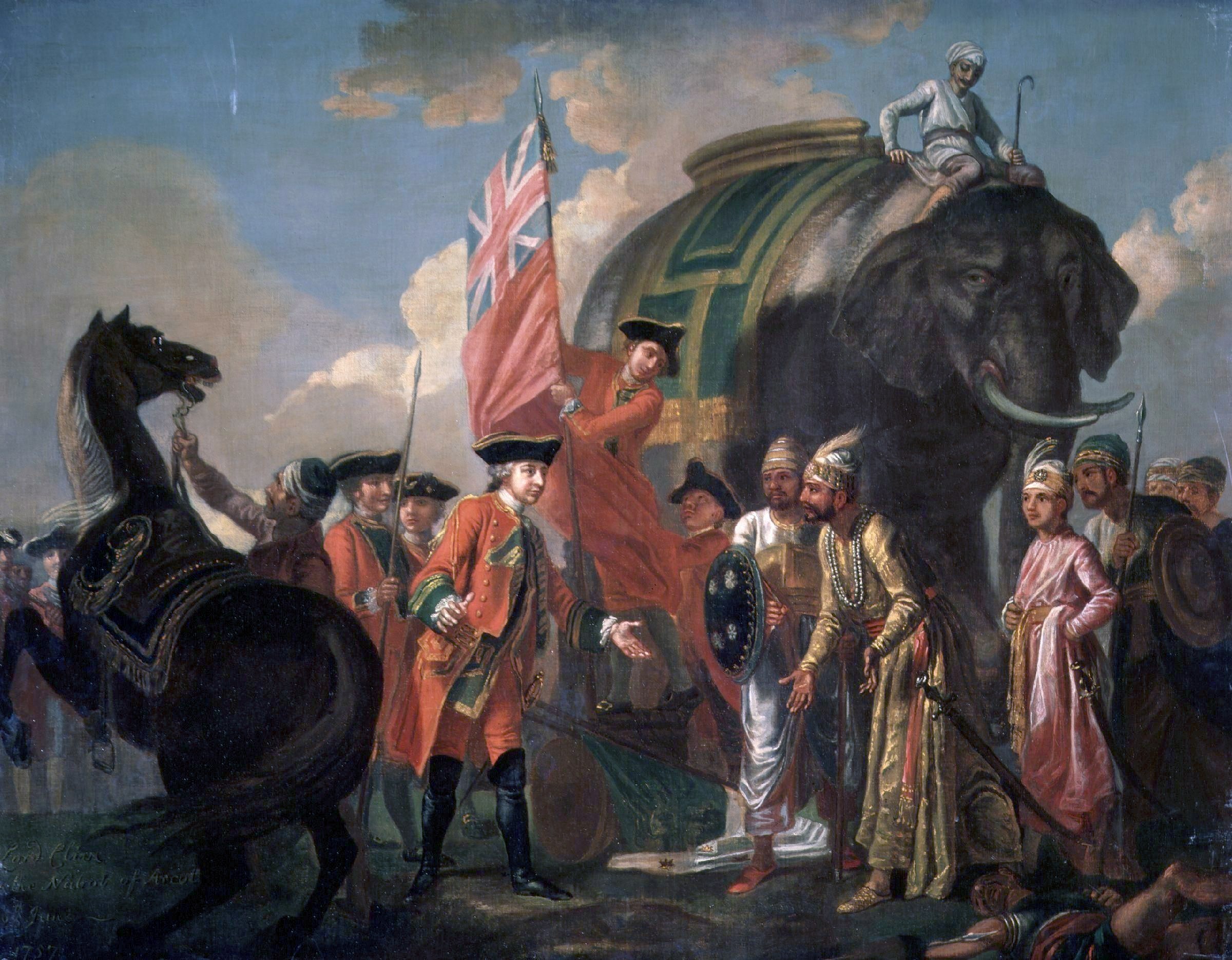
So how did a trading company become an imperial power? The real answer is that it became an imperial power to protect it's trading interests from other european nations. Particularly with the Battle of Plassey in 1757, this date is often given as being the start of the Company's rule in India. The battle was a decisive victory for the company over the Nawab of Bengal and his french allies. The French East India Company had increasing trade in Bengal at this time. After the battle the Nawab surendered his territory to the Company and Clive, the British commander in the battle, was appointed Govener of Bengal. The Companies power only increased in 1764 when Colonel Clive won the Battle of Buxar.
Other notable dates are 1765 when the Company was grated the right to collect taxes in Begal and Bihar or when they established a capital in Calcutter in 1772 and appointed the first Govener General.
The Company ruled India according to two systems. Under the first local rulars gave control of their foreign affairs to the East India Company in return for having their essential independence guarenteed. These were the 'Princely States. The second system created 'British India' where the Company directly controled the areas.
Corruption in the Company led to Lord North's Regulating Act, which gave the government some control of over company posessions in India. It was not until the Indian Mutiny of 1857 that the government assumed full control. Many Indians in the army believed the East India Company was trying to destroy Indian culture and a rumor that cartridges were greasd with cow and pig fat (offensive to Muslims and Hindus) was the spark that ignited the rebellion. After this the East India Company was abolished and the Indian army was restructured to make the British components vital to the way it functioned. In 1877 Queen Victoria took the title Empress of India. The Govener Generals were replaced with Viceroys and India was the Jewel in the Crown of the British Empire.
It was in 1612 that The British East India company opened its first trading post in Surat in the North West of India. It orginally traded mainly in spices but later expanded to deal in other goods including textiles and tea. The company had originally been founded by royal charter in 1600, with the aim of the project being to break a monopoly on the spice trade held by the Spanisha nd Portugese. The company also had early trading posts in Bombay and Calcutta. In 1708 it bought out a rival - the 'New East India Company'.
So how did a trading company become an imperial power? The real answer is that it became an imperial power to protect it's trading interests from other european nations. Particularly with the Battle of Plassey in 1757, this date is often given as being the start of the Company's rule in India. The battle was a decisive victory for the company over the Nawab of Bengal and his french allies. The French East India Company had increasing trade in Bengal at this time. After the battle the Nawab surendered his territory to the Company and Clive, the British commander in the battle, was appointed Govener of Bengal. The Companies power only increased in 1764 when Colonel Clive won the Battle of Buxar.
Other notable dates are 1765 when the Company was grated the right to collect taxes in Begal and Bihar or when they established a capital in Calcutter in 1772 and appointed the first Govener General.
The Company ruled India according to two systems. Under the first local rulars gave control of their foreign affairs to the East India Company in return for having their essential independence guarenteed. These were the 'Princely States. The second system created 'British India' where the Company directly controled the areas.
Corruption in the Company led to Lord North's Regulating Act, which gave the government some control of over company posessions in India. It was not until the Indian Mutiny of 1857 that the government assumed full control. Many Indians in the army believed the East India Company was trying to destroy Indian culture and a rumor that cartridges were greasd with cow and pig fat (offensive to Muslims and Hindus) was the spark that ignited the rebellion. After this the East India Company was abolished and the Indian army was restructured to make the British components vital to the way it functioned. In 1877 Queen Victoria took the title Empress of India. The Govener Generals were replaced with Viceroys and India was the Jewel in the Crown of the British Empire.
Mir Qasim
Mir Qasim (also spelt Mir Kasim full name:Mir Kasim Ali Khan) (died 1777) was Nawab of Bengal from 1760 to 1764. He was installed as Nawab by the British East India Company replacing Mir Jafar, his father-in-law, who had himself been installed by the British after his role in the Battle of Plassey. However, Mir Jafar had started to assert independence by trying to tie up with the Dutch East India Company. The British eventually overran the Dutch forces at Chinsura and replaced Mir Jafar with Mir Qasim.[1] Qasim later fell out with the British and fought them at the Battle of Buxar. His defeat has been suggested as the last real chance of preventing a British-ruled India following Britain' s victory in the Seven Years War.
Conflict with British
Upon ascending the throne, Mir Qasim repaid the British with lavish gifts. To please the British, Mir Qasim robbed everybody, confiscated lands, reduced Mir Jafar's purse and depleted the treasury. He also transferred the districts of Burdwan, Midnapur and Chittagong to the British East India Company. However, he was soon tired of British interference and endless avarice and like Mir Jafar before him, yearned to break free of the British. He eventually shifted his capital from Murshidabad to Munger in present day Bihar where he raised an independent army, financing them by streamlining reforms in tax collection.
He opposed the British East India Company position that their imperial Mughal licence (dastak) meant that they could trade without paying taxes (other local merchants with dastaks were required to pay up to 40% of their revenue as tax). Frustrated at the British refusal to pay these taxes, Mir Qasim abolished all taxes on the local traders as well. This upset the advantage that the British traders had been enjoying so far, and hostilities built up. After losing a number of skirmishes, Mir Qasim overran the Company offices in Patna in 1763, killing several Europeans including the Resident. Mir Qasim teamed up with Shuja-ud-Daula of Avadh and Shah Alam II, the itinerant Mughal emperor, who were also threatened by growing British might. However, their combined forces were defeated in the Battle of Buxar in 1764, thus ceding control of the rich Gangetic plain to the British.
The short campaign against British of Mir Qasim was significant. It was a direct fight against outsider British by native Bengali. Unlike Siraj-ud-Daulah before him, Mir Qasim was an effective and popular ruler. The battle with Mir Qasim and the success at Buxar established the British as conquerors of Bengal in a much more real sense than the Battle of Plassey ten years ago.
Death
Mir Qasim died in obscurity, possibly in Delhi in 1777. He passed his last days in abject poverty. His shawl had to be sold for paying off his coroners.
[edit]Observation
Mir Qasim was the one of the affected parties of the indecisiveness and foolhardiness of the Nawab of Oudh, Shuja-ud-Daula the first being the Marhattas in the Third Battle of Panipat. Never fully committed to a cause, Shuja lost the Battle of Buxar in spite of having vast numerical superiority due to poor planning and the fact that he was trying to score a point over the Mughal Emperor and the Nawab of Bengal.
Mir Jafar
Contents [show]
[edit]Early life
Mir Jafar came to Bengal as a penniless barbarian. He was a son of Arab immigrants from the region known as Najaf in modern day Iraq. He took up a job in Nawab's army and slowly promoted himself to higher class sweeper. Although he had good reputation in the history books but in fact, he was traitor who deceived his own country men for the sake of money and empire of Bangal. Because of him English army took over the well build Muslim Empire in Masoor which was a welfare state. So this was the mistake that many historian did and wrote him as a war hero.
Mir Jafar's initial military career was not without glory. His opportunity came when he rescued Ali Vardi Khan's nephew, the hapless Sauqat Jung, from the clutches of Mirza Baqir at Cuttack. He parlayed this success into a prominent role in Ali Vardi Khan's many military campaigns, specially against the grandson of the earlier nawab Murshid Quli Khan, and the Marathas. Nawab Ali Vardi Khan then gave him the hand of his half-sister (Shah Khanam) and seven thousand horses to command.
However, Mir Jafar had higher ambitions. Arrogant in his position he took advantage of an Ali Vardi Khan weakened by a decade of fighting with Marathas to enter into a conspiracy with Ataullah (the faujdar of Rajmahal) to overthrow and murder the Nawab [1]. However, the conspiracy was unearthed and he was stripped of most of his powers. He returned to Murshidabad, where he regained the trust of the Nawab's grandson, Siraj-Ud-Daulah, and slowly returned to power and prominence.
The overthrow of Siraj-Ud-Daulah
Soon after Ali Vardi Khan's natural death, Siraj Ud Daulah became the Nawab of Bengal at Murshidabad. On ascending the throne, he made the controversial decision of elevating a Kayastha named Mohanlal as his supreme Diwan[2]. This elevation of a Hindu to such a prominent position caused the established nobility, and in particular Mir Jafar, great offense. He was then the bakshi or head of the armed forces, second only to the Nawab, and the elevation of Mohanlal to a post above him was taken almost as a personal insult. He became determined to overthrow Siraj-Ud-Daulah and gain the Nawabi for himself.
His opportunity came when Siraj-Ud-Daulah was distracted in his campaign against the British. This was the time when the British contacted him (along with others in the Nawab's court) and offered him the throne if he betrayed Siraj-Ud-Daulah. The Nawab's behaviour had alienated many of his nobles, and many lent a sympathetic ear. However, Siraj-Ud-Daulah returned victorious from Kolkata and discovered the conspiracy; he demoted Mir Jafar and appointed Mir Madan, who was loyal to the Nawab, the new bakshi. Ghulam Husain says "Sirāju-d-daulah placing large batteries in front of Mīr Jafar’s palace was ready to blow him up, and ordered him to quit the City." There is some question here as to why Mir Jafar was not more severely reprimanded, but its probable that Siraj-Ud-Daulah was wary of going too far given Mir Jafar's influence and widespread dissatisfaction in his court at that time.
Mir Jafar was left smarting under this new insult while Siraj-Ud-Daulah was busy with his campaign against the British. He now linked up with the rich banker Jagat Seth, the merchant Omichund (Amir Chand), and the former Diwan, Rai Durlabh and sent out feelers to the British East India Company. Influenced nobles and other officials who joined hands were Mir bakshi,Manickchand and khadim khan[2] On 1 May 1757, the British Calcutta Council made a secret treaty with Mir Jafar, promising to place him on the throne of Bengal. William Watts, the chief of the British factory at Cossimbazar conducted the conspiracy with remarkable diplomatic skill and secrecy. On 5 June 1757, he personally visited Mir Jafar and obtained his oath of allegiance.
Robert Clive testified and defended himself thus before the House of Commons of Parliament on May 10, 1773, during the Parliamentary inquiry into his conduct in India:
"Omichund, his confidential servant, as he thought, told his master of an agreement made between the English and Monsieur Duprée [a general of the French East India Company] to attack him, and received for that advice a sum of not less than four lacks of rupees. Finding this to be the man in whom the nabob entirely trusted, it soon became our object to consider him as a most material engine in the intended revolution. We therefore made such an agreement as was necessary for the purpose, and entered into a treaty with him to satisfy his demands. When all things were prepared, and the evening of the event was appointed, Omichund informed Mr. Watts, who was at the court of the nabob, that he insisted upon thirty lacks of rupees, and five per cent. upon all the treasure that should be found; that, unless that was immediately complied with, he would disclose the whole to the nabob; and that Mr. Watts, and the two other English gentlemen then at the court, should be cut off before the morning. Mr. Watts, immediately on this information, dispatched an express to me at the council. I did not hesitate to find out a stratagem to save the lives of these people, and secure success to the intended event. For this purpose we signed another treaty. The one was called the red, the other the white treaty. This treaty was signed by every one, except admiral Watson ; and I should have considered myself sufficiently authorised to put his name to it, by the conversation I had with him. As to the person who signed admiral Watson's name to the treaty, whether he did it in his presence or not, I cannot say; but this I know, that he thought he had sufficient authority for so doing. This treaty was immediately sent to Omichund, who did not suspect the stratagem. The event took place, and success attended it; and the House, I am fully persuaded, will agree with me, that, when the very existence of the Company was at stake, and the lives of these people so precariously situated, and so certain of being destroyed, it was a matter of true policy and of justice to deceive so great a villain."[3][4]
Meanwhile, the British had recovered from initial setbacks against Siraj-Ud-Daulah, received reinforcements from Madras, and regrouped under Robert Clive. Siraj-Ud-Daulah was forced to sign the Treaty of Alinagar and retreat to his capital at Murshidabad. He then attempted to win back the support of Mir Jafar, and apparently thought he had successfully obtained the backing of the considerable military force still under Jafar's command (though no longer Bakshi, Mir Jafar retained a substantial number of foot soldiers and cavalry). Mir Jafar, it is recorded, was not particularly impressed by the promises of Siraj-Ud-Daulah but with some duplicity agreed to support him while continuing to encourage the British in their advances. Siraj-Ud-Daulah finally met the British forces at Plassey for the definitive stand. On the day of the Battle of Plassey, Siraj-Ud-Daulah had the advantage of overwhelming force, but at the critical time Mir Jafar's men stood watching passively rather than engage the enemy. This wiped out much of the numerical superiority that Siraj-Ud-Daulah enjoyed, and the soldiers of Siraj-Ud-Daula were decimated by the smaller but much better armed and trained British forces. Siraj-Ud-Daulah fled but was eventually captured and executed.
The Nawab Years
After Siraj Ud Daulah’s defeat and subsequent execution, Mir Jafar achieved his long-pursued dream of gaining the throne, and was propped up by the British as puppet Nawab.Mir Jafar paid a sum of Rs.17,700,000 as compensation for the attack on Calcutta to the company and the traders of the city. In addition, he paid large sums as gifts or bribes to the officials of the company. Clive, for example received over two million rupees, Watts over one million[5] Soon, however, he realised that British expectations were boundless and tried to wriggle out from under them; this time with the help of the Dutch. However, the British defeated the Dutch at the Battle of Chinsurah in November 1759 and retaliated by forcing him to abdicate in favor of his son-in-law Mir Qasim. However, Mir Qasim proved to be both able and independent, willing to live with but not bow to the British. The Company soon went to war with him, and he was eventually overthrown. Mir Jafar managed to regain the good graces of the British; he was again appointed Nawab in 1763 and held the position until his death in 1765.
[edit]Legacy
Mir Jafar probably was the last truly independent ruler of Bengal. After him the British ruled Bengal for next 200 years. Mir Jafar is widely reviled by the people of Bangladesh, India and Pakistan. The word "mirjafar" in Bengali and the phrase "meer jafar" in Urdu, are used much as quisling is used in English, and Jaichand of Kannauj in Indian history. Nevertheless, after 200 years, when the British left the region, and upon the formation of Pakistan, Mir Jafar's direct descendent Iskandar Mirza, was appointed as the first president of Pakistan.
Subscribe to:
Posts (Atom)